Criterion 2.2-12 of the HAS Certification Framework: Requirements and Challenges
Criterion 2.2-12: A Mandatory Element for All Healthcare Facilities
Criterion 2.2-12, from the French National Authority for Health (HAS) Certification Framework version 2025, is a mandatory element that concerns the entire healthcare facility. Its main objective is to ensure that teams are capable of managing life-threatening emergencies. This implies an immediate response and optimal coordination to preserve the patient's life. To assess mastery of this criterion, several elements are examined: At the professional level: There must be a single, dedicated phone number to contact an authorized physician in case of a life-threatening emergency, and this number must be known to professionals. All healthcare professionals must be trained in first aid procedures, including the ability to recognize a life-threatening emergency and know the appropriate course of action. Emergency carts or bags must be adapted to the patients present in the unit and easily accessible.
- An evaluation must be conducted on the overall system for managing life-threatening emergencies in order to validate its effectiveness.
In summary, Criterion 2.2-12 requires not only individual training for professionals, but also a robust systemic organization, the availability of appropriate equipment, and a continuous improvement approach based on evaluation and simulation.
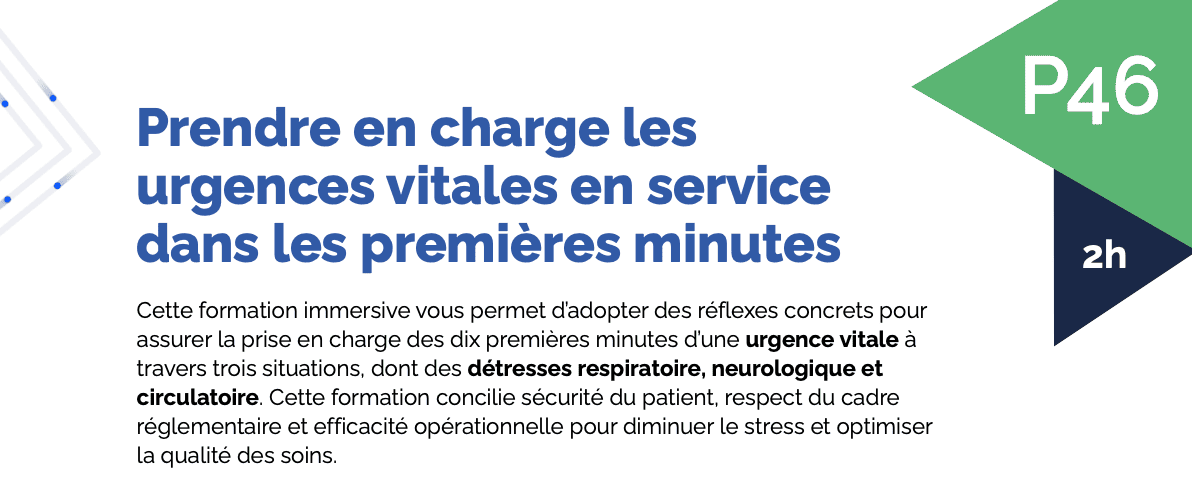
Safeteam training: a concrete response to the requirements of Criterion 2.2-12
To enable healthcare professionals to develop and maintain the skills required by Criterion 2.2-12, particularly in terms of training and simulation exercises, Safeteam offers the "Managing life-threatening emergencies in the first response unit" training course. minutes" [P46]. This training is intended for all healthcare staff.
Its structure is specifically designed for effective learning in a short period: 2 hours in total. As mentioned previously, these 2 hours are divided into two one-hour modules:
- Part 1: Independent, asynchronous (1 hour)
- This part begins with an introduction to the training and a pre-test to assess your starting level.
- The core of this hour is an immersive video simulation. You are placed in the role of a healthcare professional and must manage three successive life-threatening emergencies (respiratory, neurological, and circulatory distress). The goal is to enable you to quickly learn to analyze the situation and acquire the essential reflex actions as a first responder.
- At the end of each video simulation, an "expert's perspective" analyzes the situation.
- Assessment is continuous throughout this section through immersive role-playing, professional scenarios, and real-life cases. Interactive quizzes with immediate feedback reinforce continuous monitoring and skills validation.
- This section also includes elements to go further, with an in-depth focus on the emergency cart (its purpose, regulations in healthcare facilities, best practices for its use, inspection, and restocking) – a point directly related to the requirements of Criterion 2.2-12. Expert input from the Paris Fire Brigade (BSPP) on cardiopulmonary resuscitation is also included.
- It concludes with a post-test to measure progress and an action plan.
- Part 2: Group session via videoconference (1 hour)
- This second hour is dedicated to the debriefing of the video simulation.
- It is led by a human factors expert.
- The objective is to analyze, both collectively and individually, the situations encountered during the simulation. You are asked to identify the gaps between your practice and the recommendations for managing life-threatening emergencies and using the emergency cart.
- This allows you to target areas for improvement, both individually and as a team.
- Together, you will establish an individual and collective action plan and strengthen teamwork.
The teaching methods for this training are varied, using video simulations, case studies, quizzes, videos, and articles. The skills targeted are: Protecting (securing), Alerting (detecting and structuring the call), and Providing First Aid (implementing immediate care). One of the specific learning objectives is to know how to use the emergency cart effectively. The training is 100% online. Successful completion requires a score above 70% on the post-test and full completion of the course. By participating in this training, professionals develop concrete reflexes for the crucial first ten minutes of a life-threatening emergency. This contributes to patient safety, compliance with the regulatory framework (such as Criterion 2.2-12), operational efficiency, stress reduction, and optimized quality of care.
Source: