HAS Certification Criterion 1.1-06: The Essence of Respectful Care in Healthcare Facilities
The certification of healthcare facilities by the French National Authority for Health (HAS) aims to guarantee and improve the quality of care. At the heart of this process is respect for the fundamental rights of the patient, symbolized in particular by Criterion 1.1-06: The patient benefits from respectful care.
What is respectful care according to the HAS?
Respectful care is not simply a rule, but a fundamental principle and a culture that must permeate the entire healthcare facility. Its goal is to guarantee the respect, dignity, and well-being of every patient. This culture involves all stakeholders: the patients themselves, their families, patient representatives, healthcare professionals, management teams, administrative staff, and even the institution's governance. Compassionate care goes far beyond simply providing quality medical care (such as reception or pain management). It pays particular attention to communication (for example, when delivering a diagnosis), personalizing support, and respecting the patient's autonomy. This includes active listening, the complete absence of any form of mistreatment, and the creation of a safe and calming environment. The HAS also emphasizes that promoting the well-being of patients and their families is closely linked to the well-being of professionals, through the provision of appropriate equipment, training, protocols, and the enhancement of quality of work life. How is criterion 1.1-06 assessed? The assessment of Criterion 1.1-06 is conducted at the scale of the entire institution and is considered mandatory for certification. The evaluation criteria cover several aspects: From the patient's perspective: The evaluation considers whether the patient received appropriate responses and assistance for their basic needs throughout their care, and whether, from their perspective, professional practices were respectful and compassionate, including under pressure. From the professionals' perspective: The evaluation assesses whether the patient's autonomy in meeting their basic needs is maintained, even under pressure. The team must be able to identify risks of compromising respectful and compassionate care and implement improvement measures. Professionals must know how to report potential situations of internal mistreatment, and all stakeholders must explain their role to the patient.
The assessment is based in particular on the Tracer Pathway and the System Audit.
Adherence to Criterion 1.1-06 and the implementation of a culture of respectful care require paying particular attention to everyday situations, which can sometimes be sources of "everyday mistreatment." This can stem from established routines or a gradual deviance in behavior.
To help healthcare professionals identify these situations and develop the right reflexes, training is an essential tool.
Develop your respectful care reflexes with Safeteam
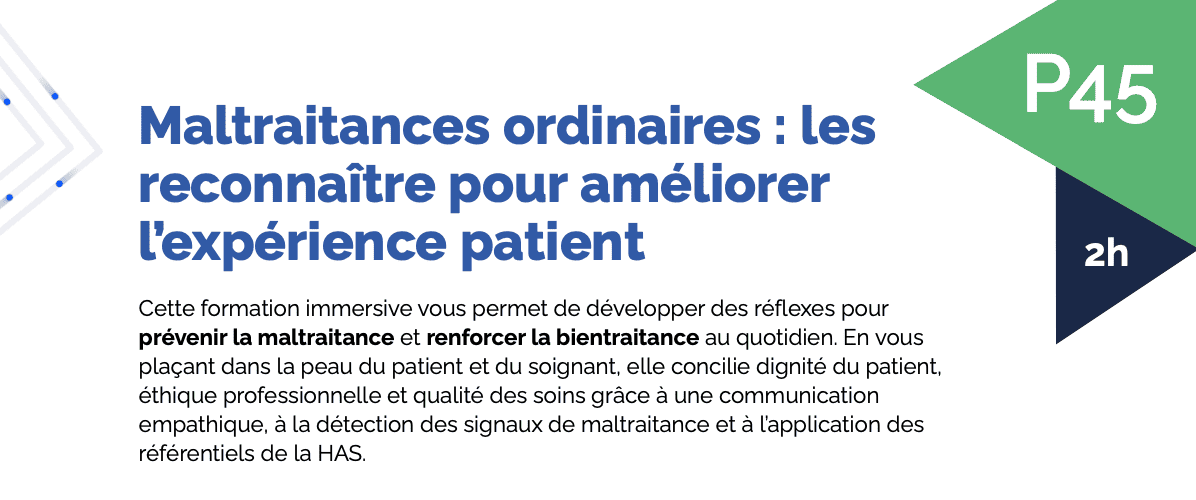
Safeteam offers training designed to address these challenges: "Everyday Mistreatment: Recognizing it to Improve the Patient Experience." This training aims to help you develop reflexes to prevent mistreatment and strengthen positive care on a daily basis. Here are the key points of this training, ideal for all healthcare professionals: Format and Duration: 100% online, for a total duration of 2 hours. It consists of a self-study component (1 hour) and a group component via videoconference (1 hour). Innovative Pedagogical Approach: The training uses immersive video simulation, real-life case studies, quizzes, videos, and articles. You will follow the journey of a patient hospitalized in the emergency room, putting yourself in the shoes of both the patient and the caregiver to become aware of everyday situations of mistreatment. The immersive video simulation will confront you with real-life situations in the emergency room, operating room, post-anesthesia care unit (PACU), etc., requiring you to anticipate and correct risks (open curtain, jargon, isolation, time pressure). Concrete Objectives: You will learn to identify situations and signs of mistreatment, to communicate with empathy to ensure patient safety, and to apply HAS (French National Authority for Health) best practices for prevention. The skills targeted include identifying signs of mistreatment and responding immediately according to HAS guidelines, adapting communication to build trust, and maintaining patient dignity. Reflective Approach: The training includes a pre-placement test and a post-test to measure your progress. The group session allows for a debriefing of the video simulation with an expert. Targeted feedback and debriefing promote a reflective approach to permanently embed best practices.
This training is an excellent way to reconcile patient dignity, professional ethics, and quality of care by detecting signs of mistreatment and applying the HAS (French National Authority for Health) guidelines. Validation is obtained by achieving a score >70% on the post-test and completing the entire process.
Investing in the training of your teams means investing in fundamental respect for the patient and in the overall quality of care, in line with the requirements of Criterion 1.1-06 of the HAS certification.
Source: