Magnetic Hospital: a model of excellence to attract and retain talent and guarantee quality of care
The concept of magnetic hospital has established itself since the 1980s as a model of high-performing healthcare facility, capable of attracting and retaining qualified and motivated staff, while guaranteeing optimal quality and safety of care. Faced with the "human resources crisis" affecting healthcare and social care organizations, the concept of the "magnet hospital" offers concrete avenues for reflection and action for a managerial transformation. The objective of this article is to explore this model in depth, its foundations, its implications, and its relevance in the current context, particularly in France.
What is a magnetic hospital? (definition and origins)
The expression "Magnet Hospital first emerged in the early 1980s following a qualitative study conducted with healthcare professionals in 41 American hospitals. At a time marked by a shortage of healthcare professionals in North America, this research focused on institutions renowned for their attractiveness and ability to retain skilled staff. The research team led by Margaret McClure, a professor of nursing, identified healthcare organizations that acted as magnets for the nursing profession. The innovative approach of this study was to focus on the reasons why healthcare professionals choose and remain in a particular institution, rather than on the factors that lead them to leave. This shift in perspective has highlighted the positive capabilities of work environments and organizations and their impact on quality of work life (QWL) and, consequently, on the attitudes and behaviors of professionals. In the early 1990s, the Magnet Hospital concept evolved into a label awarded by the American Nurses Credentialing Center (ANCC) to institutions meeting a set of rigorous criteria evaluating human resource, organizational, and managerial practices aimed at optimizing the professional practice of healthcare professionals. Used as a criterion of excellence to designate the best American hospitals, this label is now held by more than five hundred institutions, primarily in the United States, but also in Australia, New Zealand, and Canada. The Magnet Recognition Program® is regularly cited in the literature as the "gold standard" for quality nursing practices and could be considered an employer brand. Beyond its initial definition focused on attracting and retaining healthcare professionals, the magnet hospital is now perceived as an organizational context that fosters optimal performance for each healthcare professional. According to Yvon Brunelle, it is a "hospital where it is good to work and good to be cared for." This definition highlights the reconciliation between quality of work life and quality of care as a fundamental characteristic of the magnetic hospital.
The Eight Essential Dimensions of Hospital Magnetism
For over thirty years, numerous academic works have sought to identify and categorize "magnetic forces. Although the inventory may vary depending on the authors, the list of eight essential dimensions proposed by Kramer and Schmalenberg is the most frequently cited in the literature. These dimensions define the attributes of a magnetic context:
- A patient-centered culture of care: The entire organization is oriented towards meeting patients' needs and providing quality care.
- Expert caregivers: The institution values and supports the development of the skills and expertise of healthcare professionals.
- Strong institutional support for staff training: The hospital invests in the continuing education and professional development of its employees.
- Transformational nursing leadership: Nursing leadership is visionary, inspiring, motivating, and focused on the Team development.
- A participative management style that empowers healthcare professionals: Healthcare professionals are involved in decision-making processes and feel empowered to manage their work.
- A collegial working relationship between physicians and healthcare professionals: Interprofessional relationships are based on open communication, mutual respect, trust, and esteem. This relational style is statistically the most decisive factor in characterizing "loving" management.
- Autonomy of caregivers in their clinical decision-making sphere: Healthcare professionals have leeway in their clinical decisions, while respecting professional standards.
- Appropriate staffing management, adapted to the workload and patient needs: The organization ensures it has a sufficient number of qualified staff to guarantee the quality and safety of care.
These eight dimensions are interdependent and contribute to creating a positive and stimulating work environment for healthcare professionals. Validated assessment tools, such as the Nursing Work Index or the Essentials Of Magnetism Tool, allow us to measure healthcare professionals' perceptions of these "magnetic" organizational and managerial characteristics.
The Core Values of the Magnetic Hospital
Beyond its structural and managerial dimensions, the magnetic hospital rests on a foundation of core values that guide practices and behaviors within the institution:
- Care or compassion towards both patients and staff: The organization is driven by a pursuit of well-being for all, recognizing individuals' personal expectations beyond their work.
These ethical and organizational values contribute to creating a positive and collaborative culture within the hospital, fostering professional engagement and satisfaction.
Expected Effects of the Magnetic Hospital Model
Implementing the principles of the Magnetic Hospital has significant positive effects on several aspects:
- Improved performance of care: This translates into increased quality and safety of care, greater patient satisfaction, fewer complaints, and fewer care-related errors and accidents. Studies have even shown lower mortality rates in magnet hospitals.
- Greater mobilization of caregivers: Healthcare professionals report greater job satisfaction, increased professional involvement, and greater productive effort. The sense of collective efficacy is also strengthened.
- Improved physical and mental health: The magnetic model is associated with a decrease in workplace accidents, blood exposure incidents, burnout, and a better work-life balance.
- Greater attractiveness and loyalty to the organization: Magnetic hospitals experience fewer vacancies, reduced absenteeism, a stronger intention to stay, and lower turnover.
These results, based on numerous studies comparing the performance of certified and non-certified hospitals, highlight The positive impact of the magnetic hospital model on the quality of care, the well-being of professionals, and the overall performance of the institution.
The Cause-and-Consequence Model of the Magnetic Hospital
The compilation of empirical research results led to the development of a conceptual cause-and-consequence model that links the eight essential dimensions of magnetism with the empirically observed results.
This synthetic model illustrates how the eight dimensions (caregiver expertise, training support, transformational leadership, empowerment/participative management, collegial physician/caregiver climate, clinical autonomy, patient-centered culture, and appropriate staffing management) positively influence the attitudes and behaviors of caregivers (mobilization, satisfaction, involvement, intention to remain) and organizational performance (quality and safety of care, patient satisfaction, occupational health, attractiveness/retention). The model suggests that creating a magnetic work environment, characterized by the eight essential dimensions, leads to greater professional engagement and satisfaction, which in turn translates into better quality of care and greater staff retention. This virtuous circle contributes to the overall performance of the hospital. The transferability of the concept to the French context. Although the magnetic hospital model was initially developed and validated in the North American context, many authors believe it has elements transferable to the French and European contexts. While certain structural characteristics related to human resource management policies may be specific to the American hospital system, the qualitative management that underpins the concept appears more universally applicable.
This "loving" management style rests primarily on three pillars:
- Transformational leadership of frontline management: A department head or nursing manager who is stimulating, motivating, visionary, charismatic, and attentive to their staff.
- Perceived empowerment: The feeling among professionals of being able to act and control their work.
- Collegiality of the interprofessional relationship climate: Relationships based on open communication Dialogue, mutual respect, trust, and reciprocal esteem between doctors and caregivers.
A study conducted with healthcare professionals in French hospitals confirmed the importance of these three elements, particularly the collegial relationship style, in characterizing "loving" management and fostering positive attitudes at work. This study also highlighted the strong expectation of French healthcare professionals regarding teamwork and the need to overcome traditional silos between professions.
Although no French institution has yet embarked on the Magnet Recognition Program® certification process, some hospitals are undertaking initiatives inspired by this model. The idea of developing quality management, focused on well-being at work and employee recognition, is gaining traction in the French context. Practical Implications for HR: The "magnetic hospital" model offers numerous inspirations for updating human resource management (HRM) policies in French healthcare facilities. The objective is to strategically subordinate the quality of care to improving the quality of work life and developing "human capital." Here are some concrete suggestions:
- A careful recruitment policy: Select a sufficient number of qualified professionals, in line with the workload, specialties, and patient needs. Limit the use of temporary staff and promote team stability. Alignment with international best practices regarding nurse-to-patient ratios could be considered. A successful integration policy: Implement tailored support for new staff, based on an initial skills assessment and a mentoring system with experienced professionals. A strengthened training policy: Actively support qualification needs through the provision of resources (funding, leave), the organization of seminars, and interaction with the research community. Protecting training budgets is a practice of magnet hospitals.
- An incentive-based compensation policy: Promoting recognition measures that encourage innovation (awards, scholarships, special leave) and rewarding skills acquisition through career advancement.
- A policy for improving supportive working conditions: Paying particular attention to the well-being of professionals, notably by promoting work-life balance (relaxation areas, flexible hours, concierge services, etc.).
- A policy for empowering and developing managers' skills: Developing management training for department heads, healthcare managers, and physicians, and implementing collective skills management mechanisms, such as discussion forums on the work.
The implementation of these policies, adapted to the French context, could contribute to overcoming the hospital human resources crisis by improving staff recruitment and retention.
The magnetic hospital: towards an exemplary hospital?
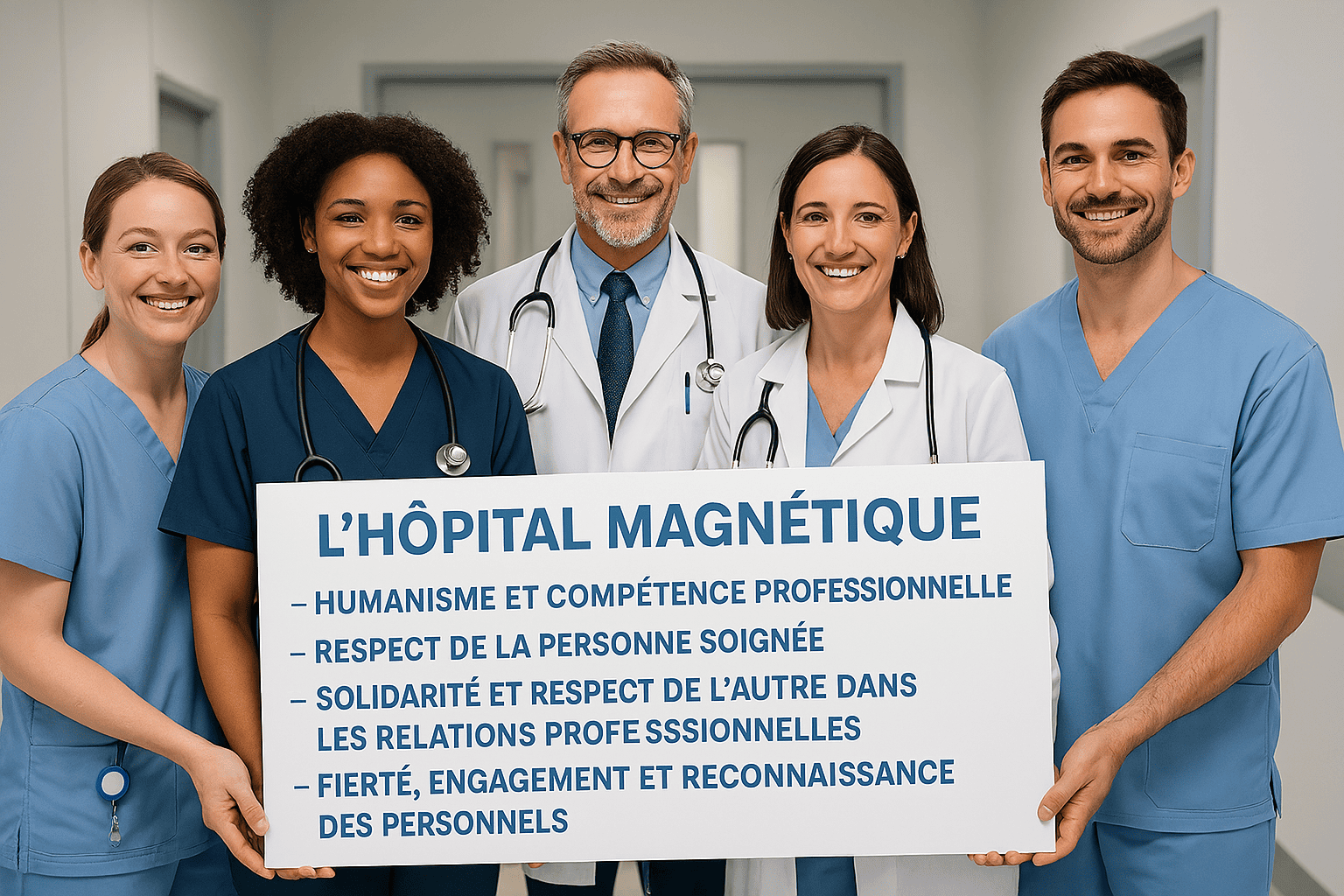
In conclusion, the concept of the magnetic hospital offers a "beneficial" perspective for rethinking the management of healthcare facilities. It encourages moving beyond an approach solely focused on preventing workplace stress and suffering to actively promote health in the workplace. The Magnetic Hospital lays the foundation for an "exemplary" hospital, in line with the values outlined in the Trust Pact for Hospitals: humanism and professional competence, respect for the patient, solidarity and respect for others in professional relationships, pride, commitment, and recognition of staff. This approach invites leaders and managers to build upon existing positive organizational and managerial capabilities, which ensure the fulfillment of hospital missions while caring for both patients and staff. While some recommendations may seem simple, they are based on solid research and deserve to be implemented with dedicated training programs. The magnetic hospital thus provides a fertile ground for fostering experimentation and the development of positive social relationships within healthcare facilities.