News dominated by mistreatment in nursing homes
Promoting respectful care and preventing mistreatment are major challenges for the healthcare system today. This is also one of the mandatory criteria for HAS certification, regardless of the type of healthcare facility.
In early 2022, the news was dominated by several accounts denouncing acts of mistreatment in nursing homes.
But what exactly is this all about?
Abuse can take many forms, as shown in the following table (source: WHO):
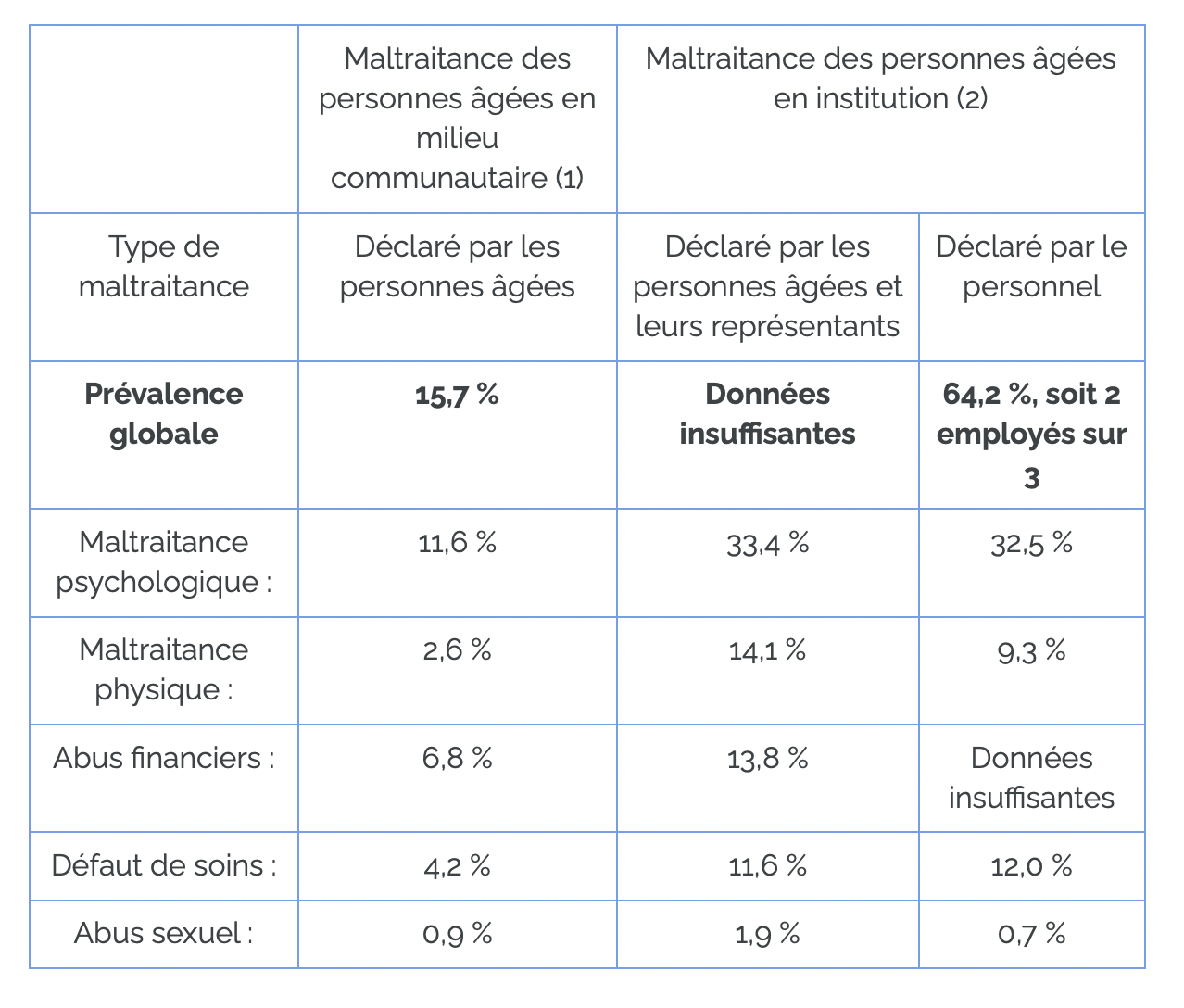
Several studies seem to show an increase in the prevalence of maltreatment during the COVID-19 pandemic. Tackling this scourge has become more than necessary.
History and Definition of Elder Abuse
Elder abuse is defined by the World Health Organization (WHO) as "a single or repeated act, or lack of appropriate intervention, within a relationship that is supposed to be one of trust, resulting in injury or emotional distress to the older person affected."
This problem is not new, however, as evidenced by the numerous initiatives undertaken and the major areas of work implemented by the WHO (and the HAS in France).
Originating in the mid-1990s in the early childhood sector, the term "positive treatment" quickly spread throughout the entire healthcare and social services sector to address the issue of abuse in care.*
Moreover, the National Agency for Evaluation and Quality The National Agency for the Evaluation of Social and Medico-Social Establishments and Services (ANESM), whose mission is to implement internal and external evaluations and provide recommendations for good professional practices, wished to define this term. Thus, benevolent treatment is defined as "a way of being, acting, and speaking, attentive to others, responsive to their needs and requests, and respectful of their choices and refusals."
This definition addresses the issues of mistreatment within nursing homes (EHPADs), making it potentially useful to promote benevolent treatment in these establishments.
According to the French National Authority for Health (HAS), promoting benevolent treatment means "strengthening a model of care and support for individuals in care facilities that is centered on their needs, expectations, and preferences." It also means encouraging user involvement in their care by placing them back in the decision-making process that concerns them.
Furthermore, promoting respectful treatment also contributes to improving the quality of care, and consequently, the health of residents.
Human Factors and Respectful Treatment in Nursing Homes: A First Thanks to the SafeTeam Academy
Always with the aim of improving practices and ensuring patient safety through training, the SafeTeam Academy is also developing a culture of respectful treatment within nursing homes with the first video-simulation module on respectful treatment and human factors in nursing homes.
Created by the SafeTeam Academy, with the support of ANFH Bourgogne and the participation of recognized experts such as Alice Casagrande, this module It develops a culture of respectful care by questioning caregivers about their practices, addressing organizational issues such as the institution's wake-up and bedtime schedules, mealtimes, and water distribution. It also highlights a scenario for managing behavioral problems in the elderly, emphasizing respect for residents' rights and freedoms, listening to them and their needs, and encouraging the reporting and prevention of mistreatment. Numerous topics are covered, including the principle of respectful care, welcoming residents, appropriate behavior, factors contributing to cognitive impairment, administering care, and crisis management. Through this solution, the SafeTeam Academy has already helped several institutions, such as the EHPAD (nursing home) in Le Creusot, where practices have been improved by raising awareness among staff about a culture of respectful care. The e-learning module can be supplemented by a debriefing and facilitated discussions aimed at improving practices.
If you too wish to develop a culture of respectful care within your facilities, opt for our Human Factors & Respectful Care in Nursing Homes module.
*HAS, The Deployment of Respectful Care, Guide for professionals in healthcare facilities and nursing homes: https://www.has-sante.fr/upload/docs/application/pdf/2012-10/bientraitance_-_rapport.pdf